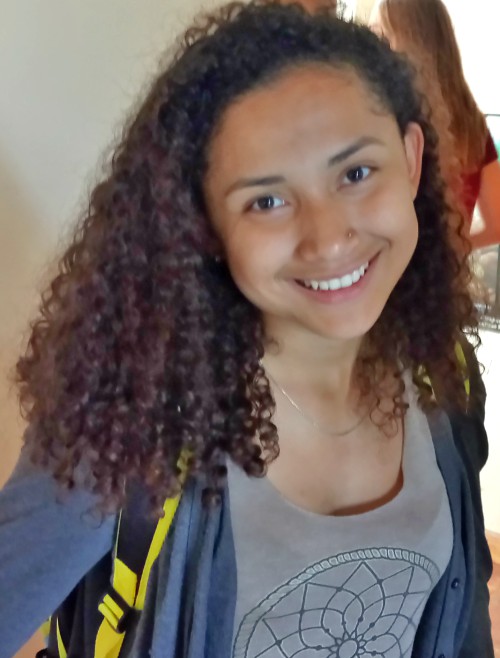
The morning after Tropical Storm Nate ravaged Monteverde, grade 12 student Tara Alana Hein walked 10 miles across swollen rivers and washed-out roads to write her SAT exam, learning a lot about herself and her country along the way:
I was born and raised on this mountain; I have the rain and mist in my blood. The mountain is in me, and I am part of it – it is my home, my soul belongs here. And yet, that night, an outside force made my hero fall to its knees. The trees bowed before the ferocious winds, the Earth surrendered to the ocean as it fell from the sky.
That night was a sleepless one, I tossed and turned as I listened to what sounded like the world falling in upon itself. I saw the face of loss in my mind’s eye, I said second goodbyes to all those who had gone. I lay there, helpless, broken-hearted, envisioning scenes of terror. I told myself the words that have been said to me a million times throughout my life, “It will be okay”.
For a girl who had grown up in what was arguably the safest place in the world, a bubble sheltered from evil by the clouds and sunshine of this tropical jungle, true fear was something foreign. I had heard of bombs, famine, poverty, the collapse of society before the force of nature – and my heart felt pangs of sorrow. Even so, this feeling of empathy was quite unfounded, as I had never lived anything of the sort. I had grown up knowing true peace, true kind-heartedness, true love and true safety. That night, I met fear. My daily woes had gone to sea, I no longer worried about what meant the world to me yesterday, and for the first time in my life, I, like those fierce forest giants, bowed before the world, and prayed to stay alive.
When a watery sun began to rise over my beloved mountain on that Friday morning, I awoke on the day of my birthday to find that the world outside had calmed. The drizzle continued to lash at the windows, and the winds continued to holler, but it was nothing compared to the horrors of the night. The hillside behind my house had come crashing down, and perhaps my prayers had been answered by nature’s mercy, for the end of the mudslide was meters away from our stables and home. Without any connection to the outside world, I had no idea that my beloved country as a whole had seen one of the most tragic natural disasters in its living memory.
As the sun’s rays grew stronger, and the wind and rain weaker, my own selfish reality slowly began to trickle back into my brain. I was supposed to take on of the first important steps towards my future independently in less than 24 hours. I had a plan. I had a process. I had a goal. Nowhere in my small mind had I accounted for something like this, I foolishly had believed that I was ready, that nothing could stop me now.
For months I had been preparing to take the SATs, and the test date turned out to be the Saturday after the storm. After the gruesome winds and rain Thursday had brought, Friday’s drizzle was tame by comparison. At this point all communication had been cut off, and there was no way to contact the school to check if the tests were still taking place. As this is an international examination, I did not think that there would be any flexibility in regard to test dates, even if our country was in a state of national emergency. I spoke to my mother, and asked if there was any way she saw us getting to Santa Elena the next morning, she did not seem too optimistic. She said that we were better off heading out on Friday afternoon, just to leave space for anything that could potentially go wrong. We doubted that there would be access to town by car, so we were resolved to walk the 13 kilometers to school. I packed my overnight bag, complete with SAT study books and a laptop to ensure that I could have access to any last minute information I might need.
We headed out around 2:00 in the afternoon, and began to walk down the main road towards the nearest town, Los Tornos. After about 200 meters into our walk, the scene that met our eyes was devastating. Two small creeks near a quarry had wreaked havoc. Huge boulders littered the previously minute river bed. The steep banks had come crashing down, and left craters where the road used to be. There was no evidence of the small, simple, bridges that used to provide access across the water, except for stranded cement drainage pipes that lay a little ways downstream. A motorcycle was parked near a small gate, and atop a hill stood four people taking in the changes the storm had made to the landscape. We joined them, and asked them if there was any chance of accessing the other side, and reaching Los Tornos. They looked at each other and shook their heads. They said that the mud was still far too wet, and that anyone who dared to cross risked sinking into the ground. We debated what to do next, and as we considered alternative routes, they told us of more landslides, and washed away bridges in Turin, Canitas, Los Olivos, Las Nubes, to name a few. 
The sun was still absent from the sky, and I began to fear that if we did not start walking soon, we would be left walking in the dark. We thanked the people, and began to head back the way we came, passed our house, and towards Las Nubes. We planned to go down through a back trail that crossed coffee fields and a small patch of forest and make a small detour to continue on our way to town. Before we reached the entrance to this trail, however, we met our neighbor, his wife, and baby boy. During the storm he had been working with ICE (the electric company) to restore electrical wires the storm’s winds had torn down. His wife was with the infant at home alone as the river roared a few meters next to their house. As there was currently no access by car to their home, they decided to stay with their family in Santa Elena for a while. They told us about the rout they were planning on taking, and we decided to join them.
We began by hiking along cow pastures. Along the way they told us stories about their families, about rivers taking away their homes, and disasters the country was facing. He told us ICE was planning on restoring electricity and cell phone signal on a national level within four days. As we were walking through high grass, mosquitoes hummed around our heads, the air was thick with humidity, and the tropical heat engulfed us. Soon sweat was pouring from my forehead and I clutched a stitch in my side. My mind began to wander, as I looked over the hills and saw dozens of small landslides scattered across the landscape.
I thought about what all the textbooks had said about the night before the SATs: “take it easy” they said, “try to relax and think about something other than the test” they said, “go to bed early” they said. Here I was, the day before the test, walking 17 kilometers through the Costa Rican countryside to reach the test center, only to show up and maybe find out the test had been cancelled.
After a while, the fields melted into forest, and we fought our way through low hanging branches and vines -there was nothing resembling a trail here. The baby was cradled in his mother’s arms, his eyes were wide and surprisingly dry. Finally, we came out onto a small drive way, and the journey became significantly easier. This relief was temporary, and soon we diverged off the beaten path once more. We came to a small stream that we had to cross, and then the continued to hike through tall estrella grass, side stepping deep mud puddles. At one point, we had to cross an electric fence, and we were all thinking about how to cross without getting shocked, before we realized that this was not a concern: since there was no electricity there would be no current in the fences! We reached the main road in Los Olivos around 5:30, tired, covered in mud, water and sweat. We were not even halfway to town yet, and dusk was approaching rapidly. Here we parted ways with our travel companions, and quickened our pace. Finally, we reached Santa Elena around 6:30, extremely grateful our straining trip had come to an end.
That evening we continued attempting to make contact with the school, and find out if the test would be administered the following morning. There was one point in Santa Elena where cell phone signal was available, and at least twenty people were standing under a street light on the wet pavement trying to reach loved ones, and find out about damage elsewhere in the country.
 We slept at a small inn, and woke around 4:30 the next morning and began heading up towards the school. So far, every one we had spoken to said the passage was cut off between Santa Elena and Monteverde, but we were determined to at least attempt to cross. We reached the creek that had taken town the small bridge over it, and three houses along with it. There was a large crater where the road used to be, although it was certainly not as hazardous as the rivers and landslides by our home. At this point there was a tree across the stream, and it was possible to climb across.
At around 7:30 we reached the director’s house. After some confusion, it seemed like I would be able to take the test. This was the end. This was the goal. Finally I could let out a sigh of relief. I began to take the test, and as I did, something strange began to happen. For some reason, it did not feel like the end. It did not feel like triumph. I began to envision what horrors the rest of my beloved country must be facing at this very moment. How many families were waking up to find their life’s work ripped apart by nature. Here I was, doing something I had thought was important, and it all suddenly seemed so trivial, insignificant, pointless, selfish.
Once I was halfway through, my mother returned, and in her eyes I saw something I had not seen there before. She had raised me as a single mother, had endured countless challenges life had thrown at her, she was always there for me, always strong. Now, I saw something different, and the frosty bite I had felt two nights ago, returned – it was fear. She told me to put it out of my mind, to focus on my test, but I couldn’t. What had happened?
The river that had taken away houses and the road in Monteverde had taken a large part of our property with it as well. The firefighters had told my mother that the house on the property was at high risk, and that she was not allowed to enter the property. Both of our properties were severely damaged, and our source of income was under immediate threat. What was going to happen next? As I sat down for the third portion of the test, my original thoughts strengthened. Even if I got the perfect score, so much else could “go wrong”; if I hadn’t accounted for something like this storm, what else had I not accounted for? What else was going to happen? I was losing something I didn’t know I had to begin with:
For the first time in my life, I worried about how we were going to have food on our table, how I was going to get to school. Even as these thoughts swirled in my mind, I thought of how much worse millions of other people had it, how much pain they must be in, how much fear must be gripping their hearts.
I looked back down at the paper, “Simplify the following expression:”, “2x+3x+8x-5x+10y+5y=11x+13y”. I began to feel dizzy, I had been drenched in mud, sweat, water, and yet, now I felt a new sensation. Tears began to roll down my cheeks, my vision became blurry. I no longer knew if I was thinking about myself, or the sorrows my country was mourning together, I no longer knew if I worried more about my future or my present, I no longer knew where I wanted to turn to, or what my next step would be. Suddenly, that breath, that sigh of relief at having reached the test center in time, became a doorway for all of those feeling I had been immune to in the face of adversity. Like the water on that dreadful night, all doubt and fear came pouring into my heart, leaving destruction behind, tearing down all those small bridges I had built for myself so far in my short life.
Throughout the next few days, as my beloved country began to lick its wounds and heal, I too began to move on. I was determined to see a silver lining amongst the dark clouds of the storm. The weeks that followed brought some of the warmest sunshine we had seen in months, almost as though the Earth attempted to comfort Costa Rica. The soulful hugs people gave each other, the smiles, and condolences, began to revive a sense of positivity. Slowly, the Pura Vida spirit engulfed people’s hearts once more. Monteverde, and Costa Rica as a whole, my hero, began to rise to its feet once more, mightier and more optimistic than before. Taking this test was supposed to be my first step in my independent life, a first step into the “adult world”, and yet, I took this step in a way I never could have envisioned. Reality had greeted me, taken me by the hand, and without my consent had tossed me into a land foreign to my innocent heart.
To grow up means to face challenges, to be thrown off the beaten path and amidst this chaos, learn to thrive, and rise stronger than when you began. What better place to do this than in a country like Costa Rica? Even when we meet fear, when we are faced with unimaginable terror, we must look inside for strength – for in order to be a true hero, we must have been able to battle the storm. Today, both my country and I, have not yet returned to the firm ground we stood on before the force of the tropical storm threw us off course, but here we are, together, “siempre echando pa’lante”. Today, we begin to rebuild, with these words as the mantra resonating in our soul.
Read more about Monteverde Friends School response to Tropical Storm Nate here

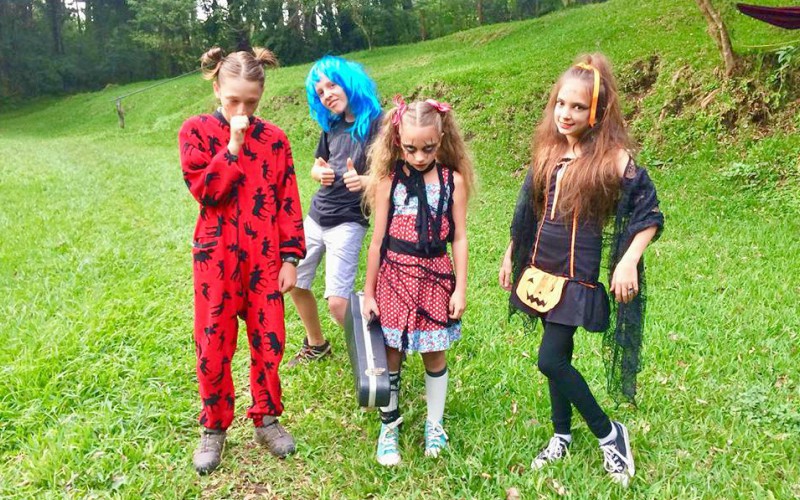
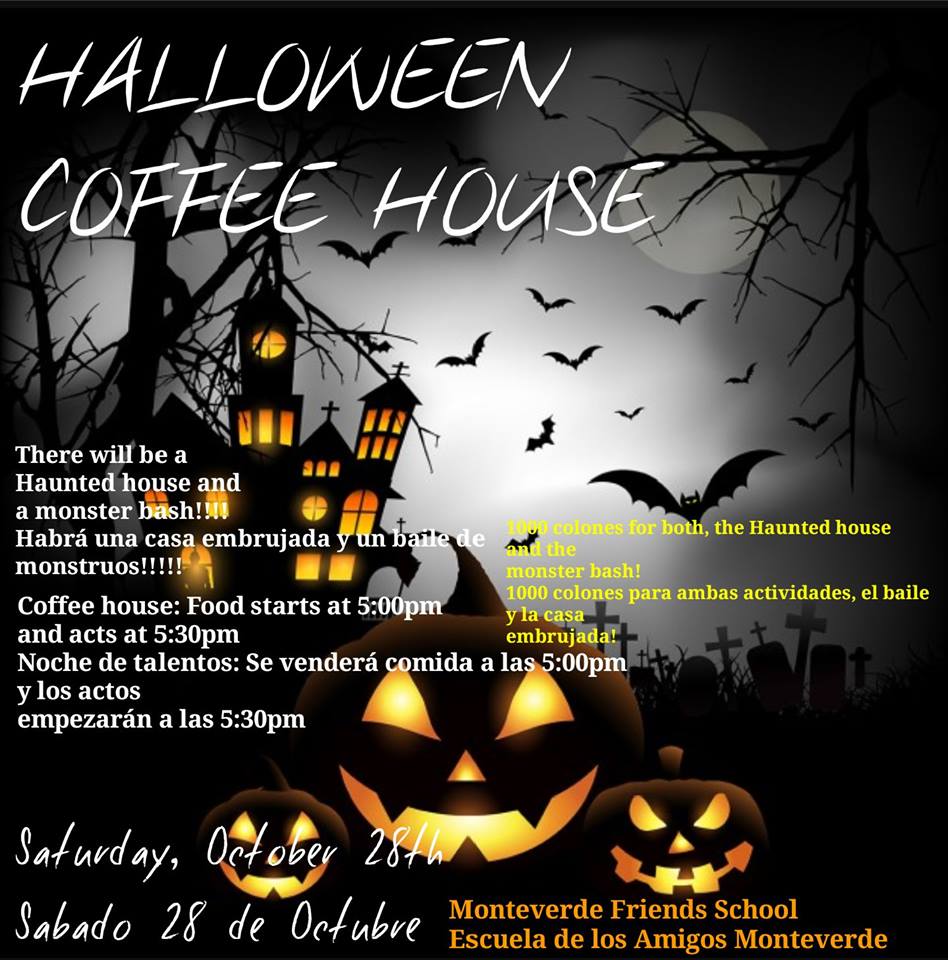 Our students, however, had no reservations. They transformed our monthly Coffee House into a full-on haunted theme. Decorations had playful skeletons encouraging us to “Zumba like a Zombie”, and the good old white bed-sheet ghosts hanging from the Meeting House ceiling. Many of the open-mic performers chose to sing about ghosts or haunting themes, and the evening’s highlight was a zombie flash mob performance of Michael Jackson’s Thriller.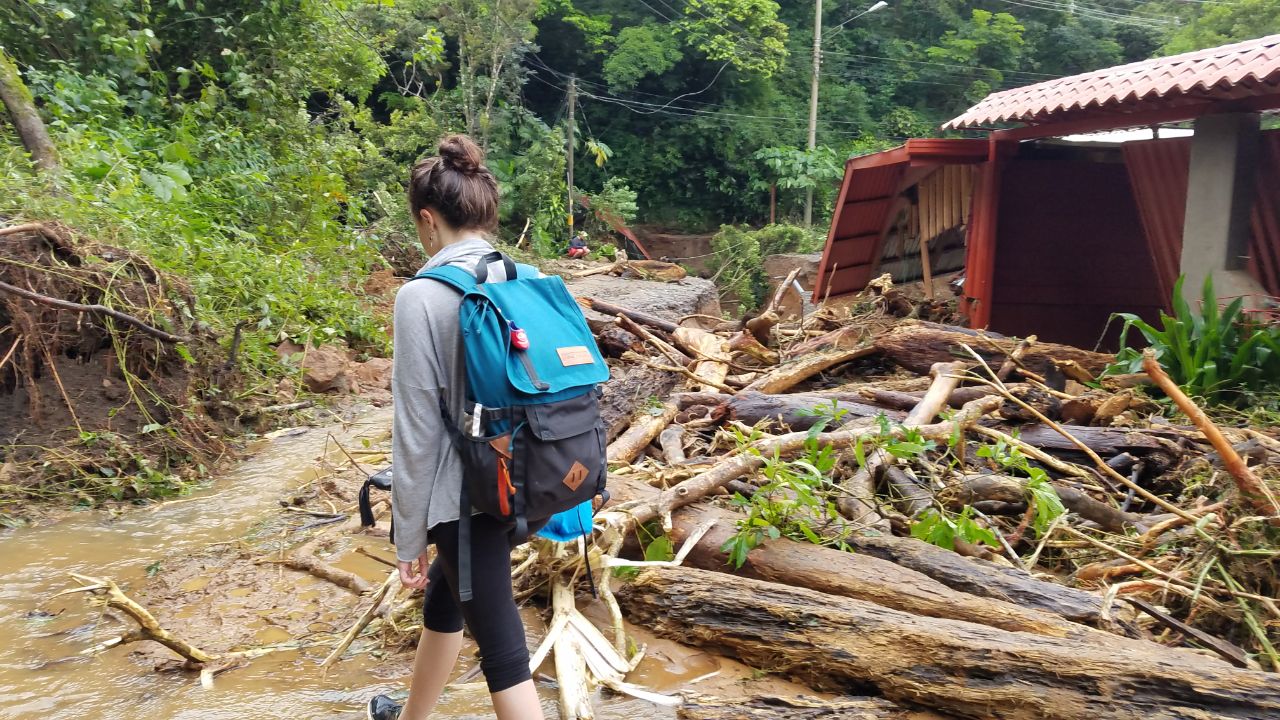


 Vaya muñeca rota y descompuesta…
 While the worst my kids faced was having to abandon their living room fort in the middle of the night to seek higher ground in their bedroom, we later heard that a school family had to crawl out through their 2nd story windows as a landslide claimed their house, car and even pets.
 The police cross a makeshift “bridge” to tell us that everyone must evacuate today – the lagoons above the Belmar are still unstable and might cause more landslides and a longer-term separation from supplies and aid in Santa Elena. But at the community meeting, officials from the municipality have also made the risky river crossing to clarify that it is up to each family to decide, and they actually recommend that most folk stay. Santa Elena is also cut off from supplies, and no arrangements have been made to house the 305 of us who are trapped on the Monteverde side. Besides, we have the dairy and the Guindon farm and the ice cream factory… Most of us decide we’re better in our own homes and community, though some who live near water or edges do move to friends’ safer houses.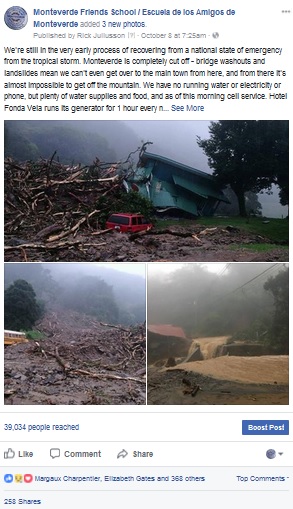

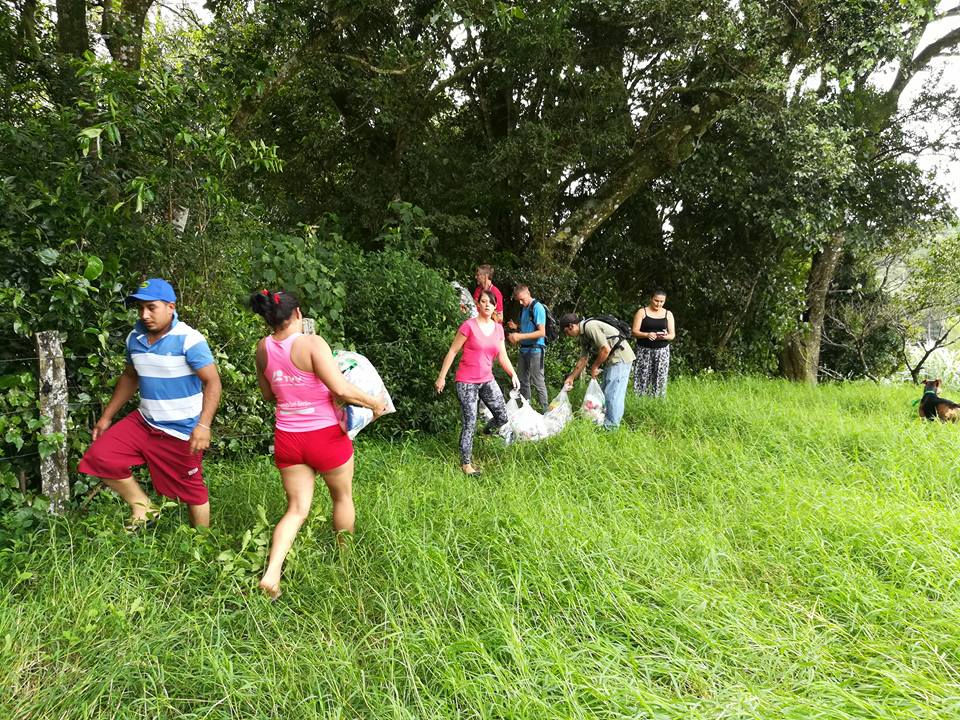 A helicopter lands in the pig field behind the school, and community members materialize out of thin air to help move water, toilet paper, rice & beans, milk powder., etc down also to the food distribution center. We follow for today’s community meeting, where we hear good news that the San Luis community has cleared their road (at the bottom) and can now get supplies in. We also talk about the fears of looting – strangers have been entering our area – and set up neighborhood watch patrols until the promised police presence can come over.
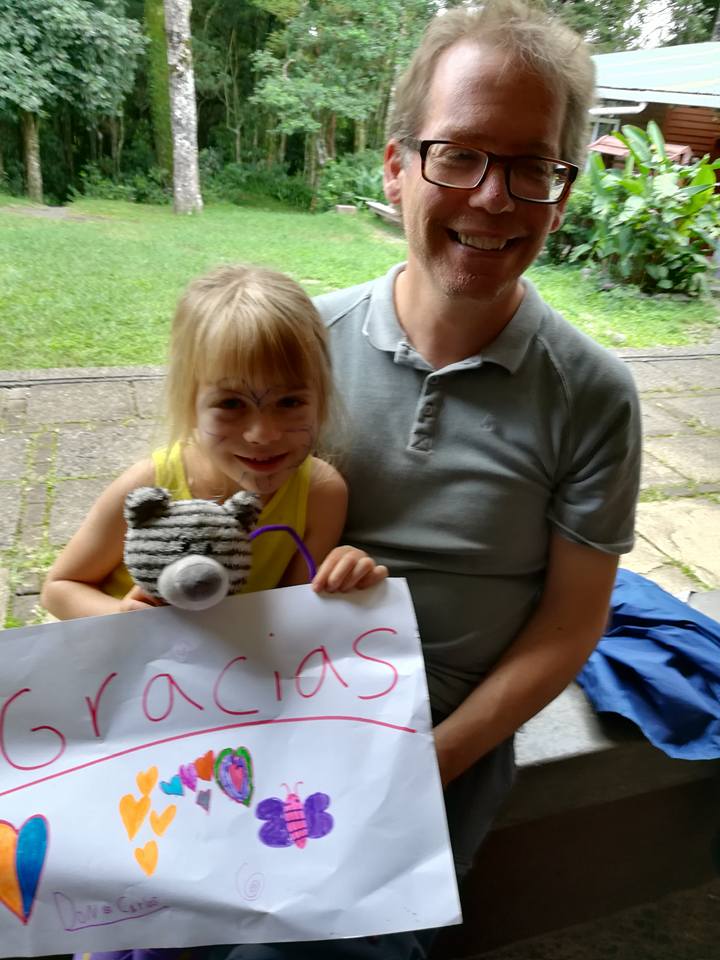 Kids camp continues, now with the addition of a community lunch thanks to the helicopter food drop, plus afternoon drum/play time at CASEM. San Luis’ ever-vigorous volunteers have opened up a walking/motorcycle path up the trocha, further connecting us to the world, and we wonder about policing/restricting the still-precarious walkway across the chasm, which more people are taking to do shopping and pay bills in town. We are ready to get back to some normal life, even though we still don’t know if things might get worse again – the rains could return, the lagoon could break – do we continue to conserve food and supplies, or get back to living?
 Machines are filling in the gorge to rebuild a temporary bridge – we might be free at last! But at the community meeting, Mayor Vargas tempers the enthusiasm by stating it’s just for emergency and reconstruction vehicles. We voice our concerns to these government officials – how can people get back to work, when can tourists return, what about medical appointments. We are ready to live again, and a system needs to be worked out so the bridge can be used by all.