“The Medium is the Message” – speech by graduating student Cristina Herrera at our 65th Anniversary celebration (español sigue):
Quakers often talk about the importance of paying attention to the “still small voice” that sometimes makes itself heard within us. The act of opening ourselves to the guidance of this light is a daily exercise at Monteverde Friends School.
I have lived here for five years. I have already grown accustomed to the day going by in this state of openness to superior guidance. I do not lose my patience with committees; I am not intimidated by the emotional and spiritual receptivity of my environment. In order to achieve harmony in all processes, everybody has equal participation, so my classmates and I are involved in every decision made. None of this seems strange to us.
 For us, life in common is the circumstance in which the ideal translates into the norm, the norm to reality, reality to challenge, and challenge to the achievement of the ideal. Sometimes it is frustrating and tiresome; other times it is tremendously satisfying. We live with the laughter and games of the children, the stumbles of the young, the wisdom of the elderly. And we live, too, with disputes and disagreements among neighbors, and with the changes brought about by death and departures.
It so happens, however, that realizing our noblest ideals tends to be a slow and tedious task devoid entirely of the splendour often attributed to it. It is not easy to live with our convictions. But this is what Monteverde has aspired to since its beginnings — to rise as an experiment in coherence and perseverance; and to be, of course, an exercise in love.
For the relationship we have with our beliefs can be as turbulent as our relationship with our fellow men. And the proof of our loyalty to a person or to a belief assumes shapes far humbler than those of the typical prodigious feat or revelation. Harmony with our ideals — which is harmony with ourselves and with the “still, small voice” that speaks to us from within — is impossible if we are not willing to transmit our dedication to that person and our faith in that conviction in all that we do.
As the philosopher and theorist Marshall McLuhan said in the 60’s: “The medium is the message.” The phrase refers to the idea that the medium through which information is transmitted often affects its recipients in ways more profound than the information itself. I don’t think I fully grasp McLuhan’s aphorism, and even less so that I know how to use it properly, but it seems to me that “the medium is the message” describes the unique nature of the manner in which MFS accomplishes its vision.
The medium creates its own language, and as with any language, it is its speakers who are less conscious of its structure. At MFS we have created and continue to create our own language. We transmit and live our ideals through rituals embedded so deeply in the patterns of daily life that we rarely notice them. The medium is the difference; the medium is what influences our way of thinking and of interacting with the world.
For focus on the process is the distinguishing trait of this school. Here we value the way in which a decision is made as much — or more — than the decision itself. Here we give as much — or more — importance to the very act of gathering in silence as we do to the messages that may arise from that silence. Here the message is lived daily in the processes, in the meaning that we bring to all that we do, however insignificant it may seem.
Because in the Monteverde Friends School we learn, just as Elijah learned in the desert, that God reveals Himself not with fierce winds and earthquakes, but with a still small voice, and that to listen to that voice we must pay attention. And that our project of life in common leads us by the hand to the daily realization of our ideals. And that the calm and stillness of the voice Elijah listened to is the purest reflection of the will of God.
La búsqueda es el mensaje: Por Cristina Herrera, estudiante de 12th grado.
Los cuáqueros suelen hablar de la importancia de prestar atención a la “still small voice” – el suave murmullo – que a veces se hace oír en nuestro interior. El acto de abrirnos a la guía de esta luz es un ejercicio cotidiano en la Escuela de los Amigos.
Vivo aquí desde hace cinco años. Hace mucho me acostumbré a que el día transcurra en este estado de apertura a una guía superior. No me impacientan los comités; no me intimida la apertura emocional y espiritual de mi entorno. Para que haya armonía en los procesos se busca que en ellos participen todos por igual; de ahí que mis compañeros y yo estemos involucrados de una u otra forma en todas las tomas de decisiones. Nada de esto nos parece extraño.
Para nosotros, la vida en común es la circunstancia en la que el ideal conduce a la norma, la norma a la realidad, la realidad a los desafíos y los desafíos a la consecución del ideal. A veces es frustrante y cansado; a veces tremendamente satisfactorio. Convivimos con las risas y los juegos de los niños, con los tambaleos de los jóvenes, con la sabiduría de los ancianos. Y convivimos también con las disputas y las desavenencias entre vecinos, y con los cambios que traen la muerte y los adioses.
Sucede, sin embargo, que la realización de los ideales más nobles es a menudo una tarea lenta y tediosa y carente por completo del esplendor que se le suele atribuir. No es fácil convivir con las convicciones. Pero es eso a lo que ha aspirado Monteverde desde el principio — a erigirse como un experimento de coherencia y perseverancia, y a ser, por supuesto, un ejercicio de amor.
Pues la relación que tenemos con nuestras convicciones puede ser tan turbulenta como nuestras relaciones con el prójimo. Y la muestra de nuestra lealtad a una persona o una convicción asume también formas mucho más humildes que la típica hazaña o revelación prodigiosa. La armonía con el ideal – que es armonía con nosotros mismos y con el “suave murmullo” (“still small voice”) que nos habla desde dentro – es imposible si no estamos dispuestos a transmitir nuestra dedicación a esa persona y nuestra fe en esa convicción en todo lo que hacemos.
Ya lo dijo el filósofo y teórico Marshall McLuhan en los 60: “El medio es el mensaje”. La frase se refiere a la idea de que el medio por el que se transmite la información tiende a afectar a sus destinatarios de maneras más profundas que la información misma. No pretendo haber entendido por completo el aforismo de McLuhan, y menos aún saber bien cómo emplearlo, pero me parece que “el medio es el mensaje” llega a describir la naturaleza única del modo en que MFS concreta su visión.
El medio crea su propio lenguaje; y como con todo lenguaje, son los mismos hablantes los que menos se percatan de su estructura. En la Escuela de los Amigos hemos creado y seguimos creando nuestro propio lenguaje. Transmitimos y vivimos nuestros ideales por medio de ritos tan arraigados en los patrones del día a día que rara vez los notamos. El medio es la diferencia; el medio es lo que influye en nuestra forma de pensar y de interactuar con el mundo.
Y es que el énfasis en el proceso es el rasgo distintivo de esta escuela. Aquí valoramos el modo en que tomamos una decisión tanto – o más – que la decisión en sí. Aquí damos tanta – o más – importancia al acto mismo de congregarnos en silencio como a los mensajes que surgen de ese silencio. Aquí el mensaje se vive diariamente en los procesos, en el sentido que damos a todo lo que hacemos por más insignificante que parezca.
Porque en la Escuela de los Amigos de Monteverde aprendemos, tal y como aprendió Elías en el desierto, que Dios se revela no con recios vientos y terremotos, sino con un suave murmullo. Y que nuestro proyecto de vida en común nos lleva de la mano hacia la realización diaria de nuestros ideales. Y que la calma y la quietud de la voz que escuchó Elías es el reflejo más puro de la voluntad de Dios.
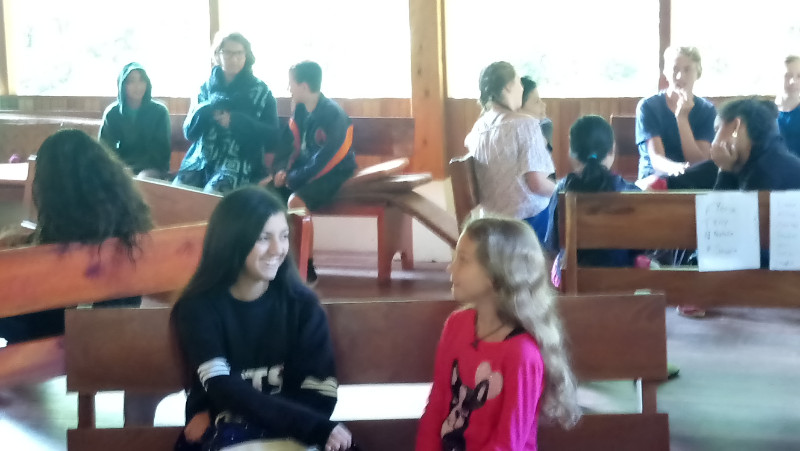
 The Primaria students divided into several groups, each with their own facilitator and preparation people, to play some co-operative games. After younger students had left, the Grade 7-8’s did a debrief with Teacher Amy to identify ways to make the meeting even better next month. Lessons in leadership start early at MFS.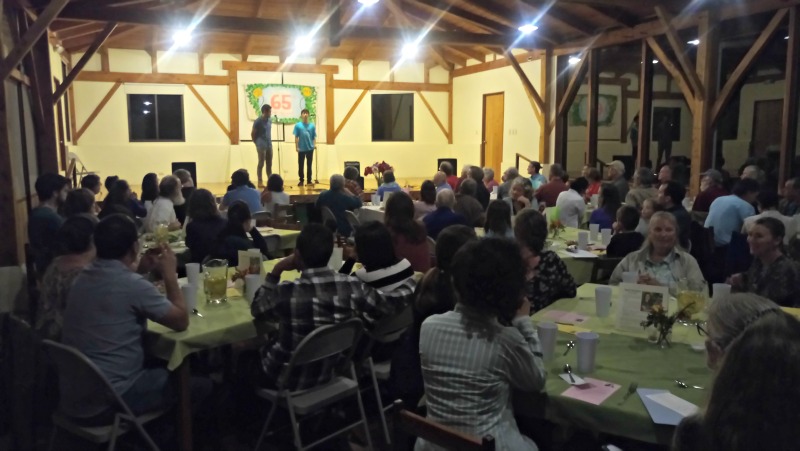


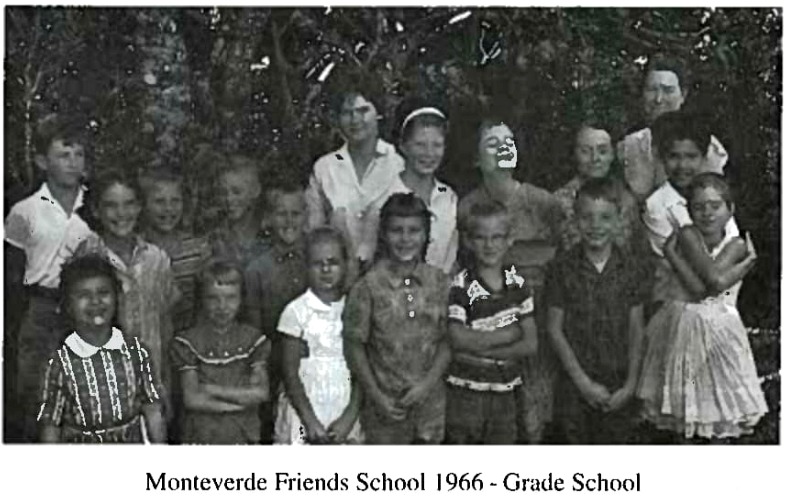
 The students were responsible for the daily cleaning of the school and for a “big” cleaning at mid-year and at the close of school. At “the house” in the beginning there was a short floorboard, which had been left loose so that it could be lifted and the dirt swept, not under the carpet, but under the house. The new schoolhouse had no such accommodations! Big cleaning days ended with a bonfire meal. Hot dogs were not available for a long time in Monteverde, but we found a recipe for bread-twists, so who needed hot dogs? Once a year, students and teachers all went on an all day picnic.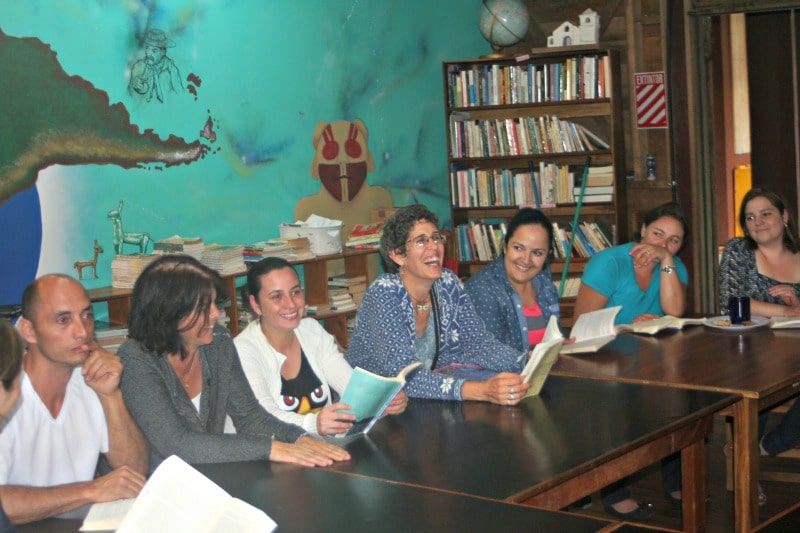
 I started in Carlos’ classroom, situated in what used to be the Quaker’s old Meetinghouse with unfinished wooden walls, a mural with a map of the Americas rotated 90 degrees from its conventional orientation, and stacks of books covering every surface. The musty library feeling of the room is befitting of Carlos, a man whose love of literature and ideas is readily apparent. He and his bilingual, high-school student, Francis, discussed their reading of Don Quixote and the Escher-like, magic cube Francis had made, which can be turned inside out, revealing a series of pen-and-ink drawings depicting Cervantes’ story. We also briefly looked at Marcos Ramirez, a Costa Rican novel written by Carlos Luis Fallas, whom another student described as “our Mark Twain.”
 She started with a brief explanation of scientific theory, but soon we were doing math (calculating the age of the theory of continental drift), listening to music while painting (Pangaea and other continental formations), and even following along as Marisela lead us in dance.
 e path to school; and the many parents who have become friends of ours over the course of this academic year. It’s been a privilege for all of us to live and grow in the Monteverde Friends School community.