Category: Uncategorized

  • Solidarity in Silence

    Solidarity in Silence

    [et_pb_section admin_label=”section”][et_pb_row admin_label=”row”][et_pb_column type=”4_4″][et_pb_text admin_label=”Text” background_layout=”light” text_orientation=”left” text_font_size=”14″ use_border_color=”off” border_color=”#ffffff” border_style=”solid”]

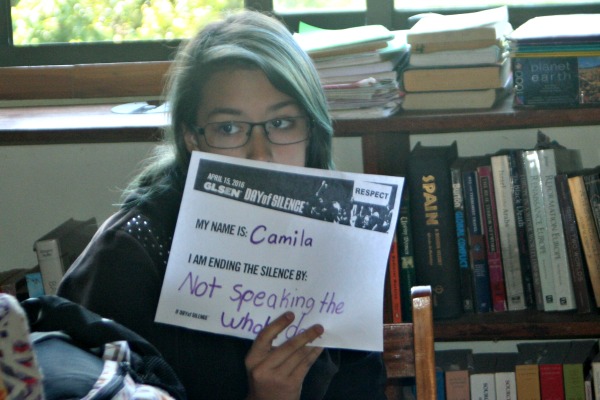
    “My name is Camila.  I am ending the silence by not speaking the whole day.”
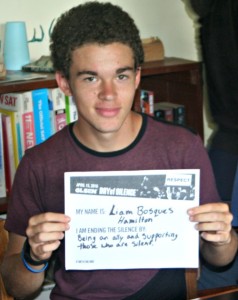
    Silence4Asking teenagers to be quiet for a whole day, in solidarity with LGBTQ students and other marginalized people around the world, was their idea.  Students wanted to once again participate in the GLSEN Day of Silence. We supported their initiative by:

    • circulating a list of participating students to all teachers so they could adapt their lessons and expectations
    • opening the day with a video about the background and philosophy of the day of silence and support for marginalized people
    • showing a video, and follow-up discussion, about homosexuality and discrimination in the Latino community
    • exploring the groups of people who experience challenges here at our school
    • holding a debriefing session with participating students at the end of the day

    Some students only made it to lunchtime, and some chose not to participate directly, but we all felt moved by the experience.  We held loved ones in the light, tried to walk a bit in their shoes, and became more aware of our communication patterns and listening skills. Learning to listen, and to appreciate the worth and different experience of others, is a core part of Quaker Education.  Gracias to the students for having the initiative and the courage to accept this challenge.

    [/et_pb_text][et_pb_gallery admin_label=”Gallery” gallery_ids=”3476,3473,3474,3478,3475″ fullwidth=”on” show_title_and_caption=”on” show_pagination=”on” background_layout=”light” auto=”on” auto_speed=”5000″ hover_overlay_color=”rgba(255,255,255,0.9)” caption_font_size=”14″ caption_all_caps=”off” title_font_size=”16″ use_border_color=”off” border_color=”#ffffff” border_style=”solid”]

    [/et_pb_gallery][/et_pb_column][/et_pb_row][/et_pb_section]
  • Financial Aid – The Hardest Committee

    Financial Aid – The Hardest Committee

    If you ever want a tough job in a small community, join your school’s Financial Aid committee!

    This dedicated group of volunteers has been working diligently over the past months to consider how best to serve the many families who have applied for financial aid. Every family has a different situation, but each believes that Monteverde Friends School is the best for their child, and each family is working incredibly hard to raise their share of the tuition.

    The committee has to balance our commitment to never turn away a local child due to lack of funds, with the need to be financially diligent. To balance their deep compassion with a healthy dose of diligence, fact-checking and discernment.

    Not content with numbers on paper, they call new families in to get to know them personally. The committee wants to develop a trust relationship, so they can feel confident that the family truly is doing all they can on their end. They look parents in the eye and find a way to work together for the good of the child and the school.

    Thanks to this hard work, we are thrilled to announce that, once again, we did not have to turn away a single child due to lack of funds. Every eligible applicant was granted what the committee believes to be an appropriate level of financial aid, allowing the child to attend school without placing an untenable burden on the family.  And there is still a reserve for new applicants or families in crisis throughout the year.

    MUCHAS GRACIAS to our generous donors who create this opportunity, and to the volunteers on the financial aid committee for doing the hard, hard work to responsibly and effectively steward these precious funds.  These flowers are for you!

    Flower

  • Crazy Week

    Crazy Week

    [et_pb_section admin_label=”section”][et_pb_row admin_label=”row”][et_pb_column type=”4_4″][et_pb_text admin_label=”Text”]

    As if there isn’t already enough fun at MFS, last week was CRAZY WEEK.  We kicked off with Hippie/Crazy Hair day, then mixed things up on Tuesday by having faculty teach different classes and grades.  Pyjama Day was a dream-come-true, and Boys-Dress-Like-Girls/Girls-Dress-Like-Boys was predictably wild.  (Note, today I caught Yuri slipping into the boys bathroom, so evidently there are still some lingering effects…)

    We capped off the week with Water Day, multiplying the insanity by inviting 22 students from Greene Street Friends School in Philadelphia and their penpal friends from schools in Naranjo and Sarchi in Costa Rica.  So we had over 130 wet, shrieking, happy students and parents on a beautiful sunny Friday afternoon in Monteverde.


    [/et_pb_text][et_pb_gallery admin_label=”Gallery” gallery_ids=”3363,3368,3381,3376,3365,3360,3375,3356,3359,3362,3377,3358,3354,3355,3361,3370,3369,3373,3364,3366,3367,3371,3380,3357,3372,3374,3378″ fullwidth=”on” show_title_and_caption=”on” show_pagination=”on” background_layout=”light” auto=”on” auto_speed=”4500″ hover_overlay_color=”rgba(255,255,255,0.9)” caption_font_size=”14″ caption_all_caps=”off” title_font_size=”16″ use_border_color=”off” border_color=”#ffffff” border_style=”solid” /][/et_pb_column][/et_pb_row][/et_pb_section]

  • Volunteer with Monteverde Friends School!

    Volunteer with Monteverde Friends School!

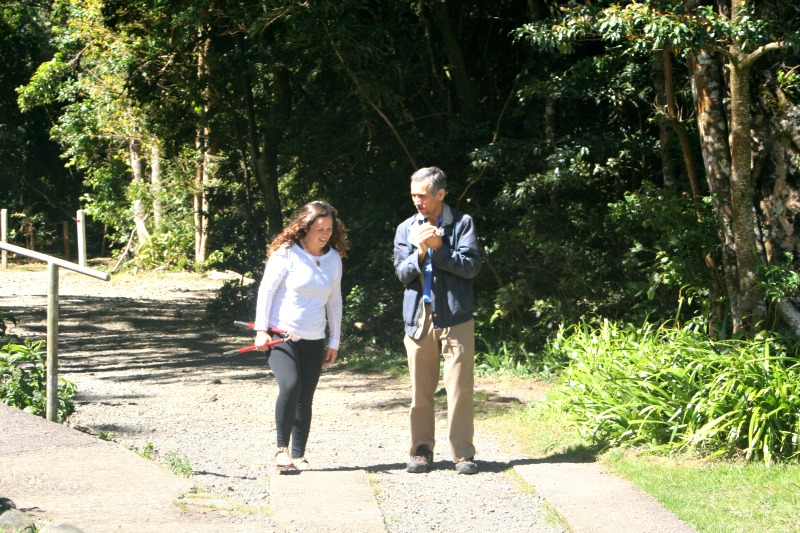
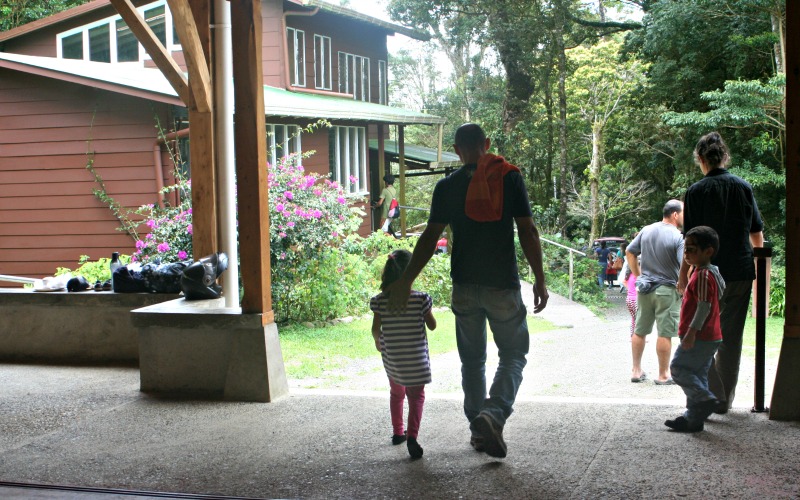
    In January we were blessed with over a dozen committed volunteers, helping in the classroom, the garden, the office, and all places in between. Some are “snowbirds”, coming back every year to share their energy, while some come for a shorter time. Some also enjoyed our new short-term homestay program, enjoying the experience of staying with a school family. But all make a huge, unique contribution to our school and community. Below is the perspective of Linsey (pictured above, and below with volunteer coordinator Eugenio Vargas), who joined us for one brief but very full week.

    “Volunteering at Monteverde Friends School in its simplest form is an opportunity to connect to a vibrant and caring community. Although my time at the school was brief, only one week, it was the highlight of my month exploring Costa Rica. At the school I was able to help on a number of various projects such as gardening, organizing, and leading a few activities and games with the kids. Everyone was extremely welcoming and appreciative of my presence and small contributions.

    The best part of my volunteer experience was the homestay, the family I lived with have two children that attend the school and I loved every second of getting to know them. After school I’d often go on a hike around their family farm or play soccer with the youngest brother and his cousins. Then over dinner I’d get a chance to talk to the oldest daughter and their mother about their lives and interests, and share about myself as well. Not to mention the delicious Tican meals their family provided!

    My experiences with the school and homestay gave me a strong feeling of togetherness and family. I sincerely home to return one day and experience more of what this wonderful place has to offer, in addition to contributing more of what I learn from my life and career.”
    Volunteer Linsey gets direction from Volunteer Coordinator Eugenio Vargas

  • How do I teach thee? Let me count the ways!

    How do I teach thee? Let me count the ways!

    From dressing up as famous cell biologists to baking organismacally-correct cakes, high school science teacher Evan Cantu-Hertzler shares the multi-faceted way (and why) he teaches:

    TeachJello_Cellers are by nature multitasking experts. They are required to be masterful at the delivery and buildup of content, while accommodating multiple personalities. Behind the scenes, many teachers are now pressured to produce high-test scores from their student or suffer a penalty. While the expectation for all students to achieve at a high level my not be realistic, teachers can provide opportunities for students to progress in their levels of understanding. A method that many teachers are now implementing relates to the idea of using and sequencing multiple teaching modes.

    Robert Hook, discoverer of the cell, graced the classroom
    Robert Hook, discoverer of the cell, graced the classroom one day.

    During the first quarter, students in grades 7 and 8 learned about cell anatomy and cell theory. With a range of academic and age abilities, I sought to implement multiple modes of instruction to reach the range present in my class. To do this I made sure to include levels of gaining personal experience through observation and exploration, direct instruction and kinesthetic and creative projects.

    In creating personal experience I had students observe and listen to “famous” guest speakers (in which I would dress up and act out the part), explore cells under microscopes, visualize images of cells, and work in difference sized groups; small, large and even individual. Students were then directly given class notes to copy key ideas and definitions. To sequence this appropriately students then completed creative tasks to practice applying their knowledge using the evidence they were given. Such as, writing a letter, making a small skit, song, dance or even advertisement. Additionally, students were given direct ways to practice such as matching definitions, making flashcards and doing readings.

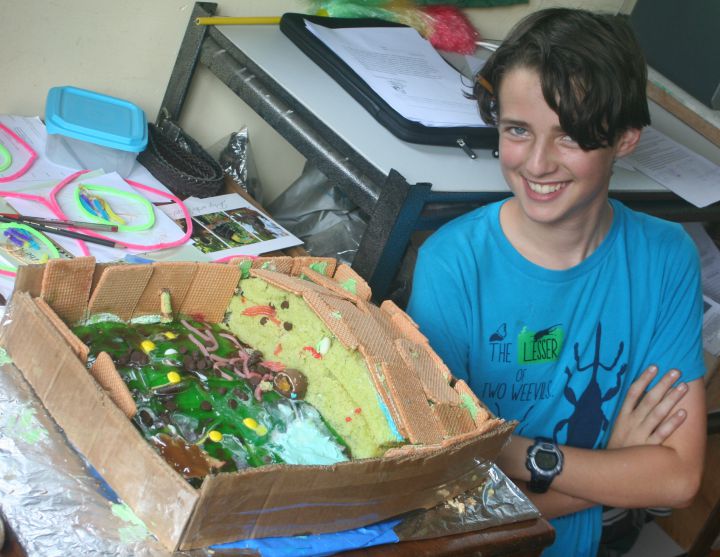
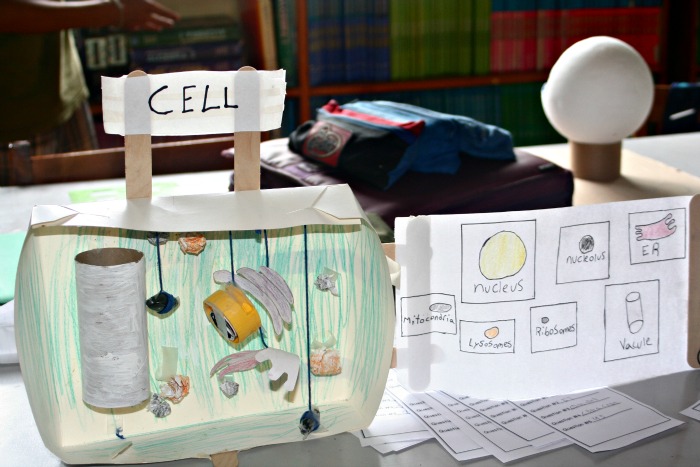
    3-D model of a cell (unfortunately, not one of the edible ones)
    3-D model of a cell (unfortunately, not one of the edible ones)

    I asked students to imagine the school, Monteverde, their family, or the country were a cell. Then they were asked to determine the organelles that allow these analogies of cells to function. This provided an opportunity for students to internalize the information and make sense of it on a more personal level, as well as to additionally push students away from a concrete understanding towards a more dynamic one.

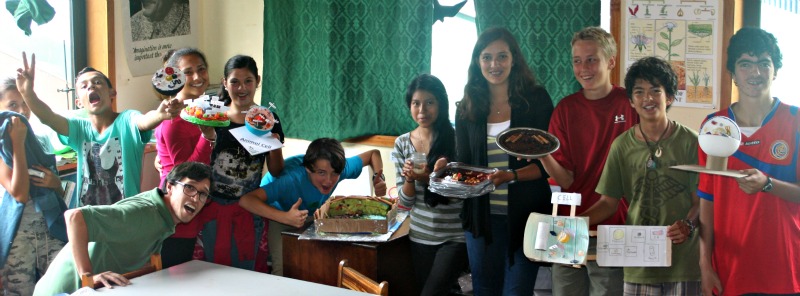
    To assess learning, students were given projects to create a 3D model of a cell and describe its anatomy and a definition of its function, and why they chose to illustrate specific organelles the way they did.

    Throughout that first quarter students were given multiple modes of instruction that I believe allowed more of the class to engage with the complex concepts of the cell and that they walked away with a solid foundation for cellular biology because of it.

    cellsb

    Cells

    Cellsc